Galatea responds
Character, conversation and emotional state shape the response.
Personality + memory
FUTURE · PHYSICAL EXPRESSION
Today, Galatea gives a digital character a voice and a face. Our next direction: carry that expression into a physical robot.
A smile starts in software. Small motors can bring it into the real world.
See how it works ↘Development direction · robot integration still to be validated
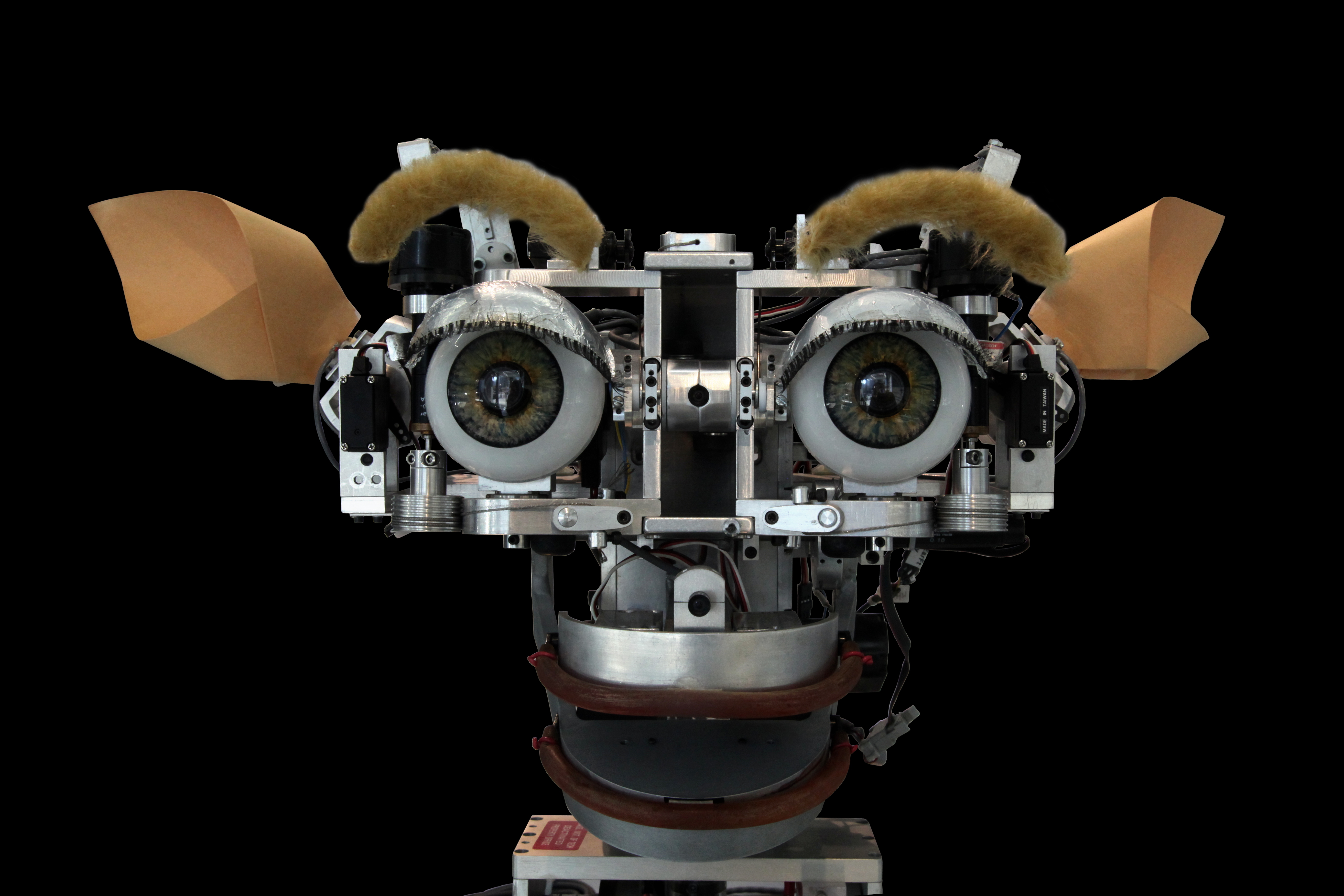
“Blendshapes” are expression controls: how much to smile, blink or open the mouth. They describe a face. A robot-specific translator turns those values into movement.
Character, conversation and emotional state shape the response.
Personality + memorySoftware describes the intended smile, blink and mouth movement.
Blendshape valuesA calibrated mapping converts expression signals into commands for that particular face.
Robot-specific integrationMotors pull cables or move linkages beneath the skin.
A physical expressionProposed Galatea integration. The research below demonstrates the expression-to-motor principle; it does not demonstrate a completed Galatea deployment.
The opportunity is to carry Galatea’s personality, memory and expression logic from a screen to a physical face.
Galatea provides the conversational character. A hardware partner provides the robot and the controls needed to move it.
Match the expression controls, calibrate the motors, then test movement limits, timing and expression quality on real hardware.
Start with Ameca and Mesmer from Engineered Arts: physical robots showing facial movement and the mechanisms behind it. The videos demonstrate expression; they do not establish the exact blendshape-to-motor mapping.
Human facial motion captured with ARKit and mapped to a robot.
Video owner: Engineered Arts · Open on YouTube ↗▶Two moving heads: one with skin, one showing the mechanism.
Video owner: Engineered Arts · Open on YouTube ↗▶A physical robot face that anticipates and mirrors a smile.
Video owner: Columbia Engineering · Open on YouTube ↗ExFace explicitly maps blendshape signals to physical robot motors. Its authors report tests on two different robotic faces.
A cable-driven robotic face. The study maps expression values to facial motor commands.
Read the hardware description ↗A second robot using articulated linkages. The authors report validating the same approach on this different mechanism.
Read the two-robot evidence ↗“mapping from human facial blendshapes to bionic robot motor control”— Zhang et al., ExFace, abstract (2025) [1]
Each robot needs a mapping between expression values and its own motors. Those values are not universal motor commands. Calibration must account for the face’s mechanics, available movements and operating limits. A completed Galatea-to-robot integration has not been demonstrated here.
[1] Dong Zhang, Jingwei Peng, Yuyang Jiao, Jiayuan Gu, Jingyi Yu and Jiahao Chen. ExFace: Expressive Facial Control for Humanoid Robots with Diffusion Transformers and Bootstrap Training. ShanghaiTech University, 2025. arXiv:2504.14477v1. See the abstract, Introduction and § III. Paper ↗
[2] Apple — ARKit, ARFaceAnchor.blendShapes. Documents expression values for features such as blinking and jaw opening. Documentation ↗
Robot names and third-party videos belong to their respective owners. Videos are linked to their original publishers; no third-party footage or research figures are reproduced here. The Kismet photograph by Rama is reused unchanged under CC BY-SA 3.0 FR, with its source and licence linked beside the image. The process diagram is an original conceptual illustration. References do not imply a partnership, endorsement or permission to use the researchers’ software commercially.
Discuss a robot integration ↗ See Galatea’s current demonstrations ↗